Quick answer
Spend most of your time in the city and one day outside it. In town, walk the medina and the souks, see Jemaa el-Fna after dark, visit the Bahia Palace, the Ben Youssef Medersa and Jardin Majorelle, and book a cooking class or a hammam. Outside, pick a sunset dinner on the Agafay plateau, a day in the Ourika Valley or a walk near Imlil.
The medina on foot: souks, the square and rooftops
Jemaa el-Fna changes through the day. Juice sellers and henna artists work the mornings, drummers and storytellers take over in the afternoon, and the food stalls open after dark. UNESCO lists the square's street culture as intangible heritage. Watch the sunset from a cafe terrace above the square, then walk down through the stalls.
The souks run north from the square and are still mostly grouped by trade: slippers and leather, metal lanterns, spices, carpets, woodwork. Go in the morning when it is calmer, carry small notes and haggle politely. Saying no with a smile and walking towards the door is normal. An offline map helps. You will take wrong turns, but the main lanes all lead back to the square.
Find a rooftop. Riads and cafes all over the medina have terraces looking across the flat roofs to the Koutoubia minaret and, in winter and spring, the snow on the High Atlas.
Palaces, monuments and museums
The Bahia Palace was built for two grand viziers, father and son, in the late 19th century. It has painted cedar ceilings, zellige tiles and courtyards shaded by orange trees. The Ben Youssef Medersa, an old Quran school reopened after a long restoration, has one of the finest carved courtyards in the country.
The Saadian Tombs and the ruins of El Badi Palace both date from the 16th century and are a short walk apart in the kasbah quarter. Get to the tombs at opening time, because the main room is small and the queue grows fast. El Badi is a huge ruin with high walls, sunken gardens and storks on the walls. Repair work since the 2023 earthquake may close some parts.
For museums, try Dar Si Said for the national carpet collection, Le Jardin Secret for a restored riad garden in the middle of the medina, and the Maison de la Photographie for old photographs of Morocco and a rooftop cafe. Non-Muslims cannot enter the mosques, including the Koutoubia, but the minaret and its gardens are open to all.
Gardens: Majorelle and others
Jardin Majorelle was planted by the painter Jacques Majorelle and later saved by Yves Saint Laurent and Pierre Bergé. It is the most visited garden in the city. Buy a timed ticket on the official website and take the first morning slot. The Yves Saint Laurent Museum next door closes on Wednesdays. The garden does not.
The Menara gardens are an old olive grove around a large pool and pavilion. They look best in late afternoon, with the Atlas on the horizon. The Cyber Park, between the medina and Gueliz, has free shaded benches for a break.
Majorelle is in Gueliz, about thirty minutes on foot from Jemaa el-Fna. Many people combine it with the medina in one day using a car and driver, which saves the midday walk and haggling with taxis.
Food, cooking classes and hammams
Try tanjia, meat slow-cooked in a clay pot in the embers of a hammam furnace. Also tagines of every kind, harira soup, msemen flatbread at breakfast, and the grills and snail soup at Jemaa el-Fna at night. Mint tea comes with everything.
Cooking classes are popular. A good one starts with a market visit to buy spices and vegetables, then you cook a tagine and bread. Some are in the medina. Others are on farms outside the city, and we can drive you there.
Go to a hammam at least once. Neighbourhood public hammams are cheap and used by locals: bring soap, a scrub mitt and a towel. Riad and hotel hammams cost more and add massages. Either way you get black soap and a hard scrub.
Sunrise and sunset outside the city
A hot-air balloon at dawn is the best-known early-morning trip. Pickup is well before first light, the balloon drifts over farmland with the Atlas behind, and most operators finish with breakfast in the countryside. Flights depend on the wind, so book early in your stay to leave a spare day.
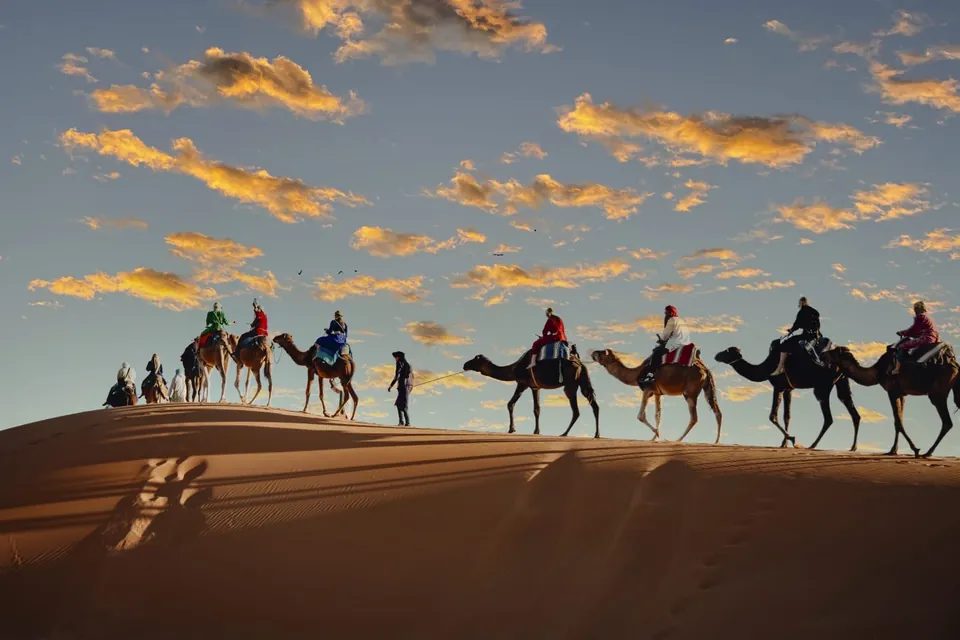
The Agafay plateau is 28 km from the medina, about 45 min by road. It is stony hills, not sand dunes. Camps serve dinner outdoors, usually after a camel or quad ride at sunset. A private car takes you there and collects you after dinner, so you are not tied to a group shuttle. Send the camp name and the desk quotes one price for the car.
Lalla Takerkoust lake is on the same side of the city and makes a quiet lunch stop, with restaurants on the shore and the mountains reflected in the water.
Day trips: Atlas, waterfalls and the coast
The Ourika Valley is the easiest half-day or full-day trip. The road follows a river into the High Atlas, and at Setti Fatma a path climbs past a series of waterfalls. We send a car and driver for the day, quoted per car before you go.
Imlil, below Toubkal, is the start of walks through Berber villages and walnut groves. The Ouzoud waterfalls, among the tallest in Morocco, are a longer day at about 3 h 10 each way. For either one, the desk quotes one price for the car and driver.
On the coast, Essaouira is 2 h 45 away: a walled port town with ramparts, blue fishing boats and fish grilled on the quay. Ait Benhaddou, the earth-built village over the Tizi n'Tichka pass, is a long day with a lot of mountain road. Ask the desk for a quote for either.
Getting around and planning your days
In the medina you walk, because most lanes are too narrow for cars. Petit taxis cover the rest of the city. Agree the fare or ask for the meter before you set off. For a day with several stops, such as Majorelle in the morning and the southern palaces in the afternoon, a car and driver that waits between stops is the simplest. Ask the desk for a half-day or full-day quote.
Spring and autumn are the most comfortable. Summer afternoons are very hot, so sightsee in the morning and late afternoon and spend midday by a pool or over a long lunch. Winter days are bright and mild, but nights are cold, especially in the desert.
Three days covers the main sights plus one day trip. Airport transfers and rides around town are quoted on request. Send your plans and the dispatch desk replies with a per-car price before you travel.
Related routes and trips
Morocco airport transfer prices and booking questions
If I do one thing in Marrakech, what should it be?
Watch Jemaa el-Fna at sunset. Start on a terrace above the square, then go down among the food stalls and musicians. The square is a different place after dark.
How many days are enough for Marrakech?
In three days you can see the medina, the palaces and Jardin Majorelle, plus one day trip to the Atlas, Agafay or Essaouira. With four or five days you can add a second trip and slow down.
What is there to do in Marrakech after dark?
Eat at the Jemaa el-Fna food stalls, drink mint tea on a rooftop, or drive out to an Agafay camp for dinner under the stars and come back by car.
Is Marrakech worth visiting in 2027?
Yes. The medina, palaces and gardens are open, flights from Europe are short, and the Atlas and the Agafay plateau are less than two hours away, so one trip can include city, mountains and desert.
What should you not miss near Marrakech?
The Ourika Valley and Imlil in the High Atlas, a sunset on the Agafay plateau, and Essaouira on the Atlantic coast. Each one is a day trip by car.
What should I wear in Marrakech?
In the medina, light clothes covering shoulders and knees are comfortable and respectful. Wear sturdy shoes for the lanes, bring sun protection in summer and a warm layer for winter evenings and the desert.